

Dallas-Fort Worth and Houston have the shortest estimated timelines for saving the upfront costs of a starter home among the 10 largest metropolitan areas, according to an October 22 report.
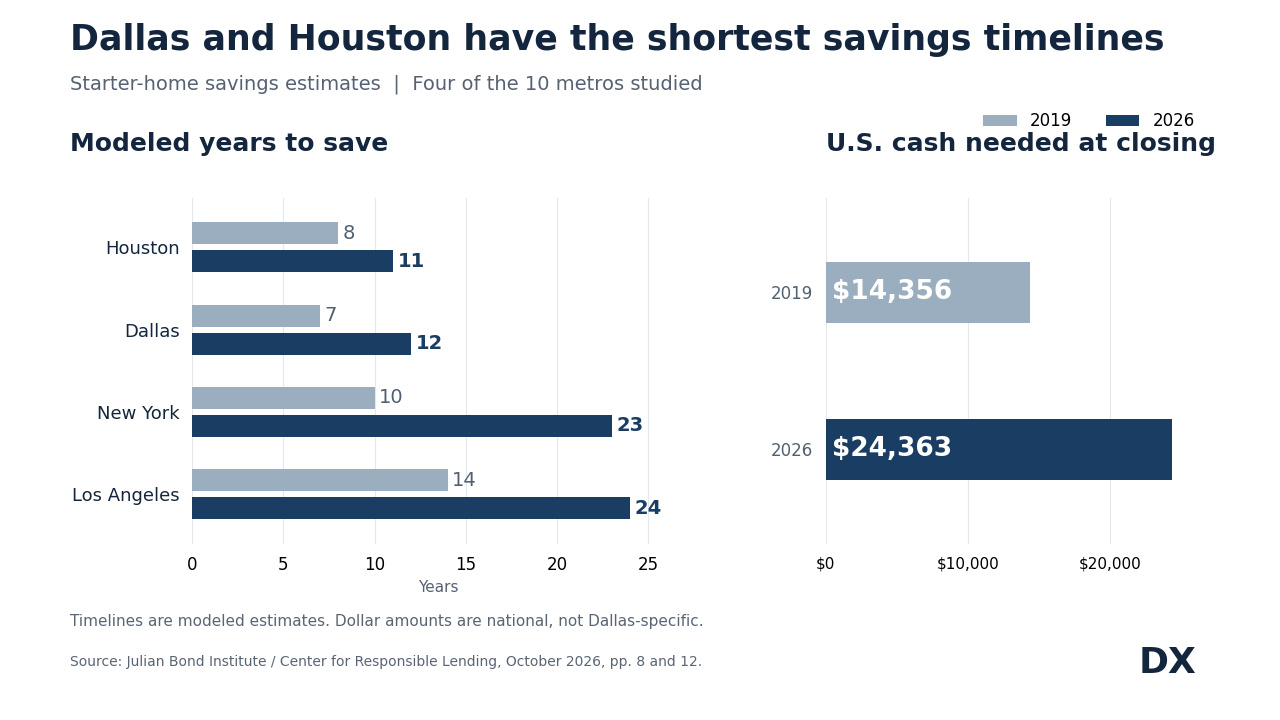
The Julian Bond Institute, a research initiative of the Center for Responsible Lending, estimates 12 years for Dallas and 11 for Houston, compared with 23 years in New York and 24 in Los Angeles. Its 2019 estimates were seven years for Dallas and eight for Houston.
The report puts the national upfront savings target at $24,363 in 2026 for a 3.5% down payment and closing costs. Its comparable 2019 estimate was $14,356. The national modeled timelines are 16 years and eight years, respectively.
National estimates in the report
| Measure | 2019 | 2026 |
| Starter-home price | $217,520 | $335,574 |
| Down payment (3.5%) | $7,613 | $11,745 |
| Closing costs | $6,743 | $12,618 |
| Total cash needed | $14,356 | $24,363 |
| Modeled annual savings | $1,693 | $1,525 |
| Years to save | 8 | 16 |
These dollar figures are national estimates; Dallas has a separate savings-time calculation. The timelines reflect house prices, closing costs, incomes and an assumed savings rate, rather than home values alone.
The 2019–2026 comparison spans several phases of the housing market. The Federal Housing Finance Agency’s national index rose 11.7% in 2020, then 39.2% from December 2020 to December 2024, spanning the Biden presidency. It rose 3.0% from December 2024 through July 2026.
Dallas’ separate Case-Shiller measure rose 41.5% from December 2020 to December 2024, then fell 2.6% through July 2026. Most of the earlier increase came in 2021 and the first half of 2022. Slower inflation does not erase earlier price increases.
An August 2012 Center for Responsible Lending brief, preserved in FDIC records, estimated 10 years to save for a 3% down payment and closing costs, or 13 years with 5% down.
That analysis used 2010 national home prices and household incomes and assumed 2% of gross income went toward the purchase. Its assumptions differ from the new report, preventing a direct comparison. It nevertheless documents a savings barrier predating the recent housing surge.
The new report prices a starter home at 80% of the median existing-home sales price. It applies a national savings rate, adjusts for taxes and allocates 75% of savings toward buying a home.
The authors estimate 2026 renter incomes using 2024 Census data and newer earnings figures. These are modeled timelines for households starting to save, not observed waits. Existing savings, assistance and financing choices can change the result.
The researchers recommend allowing more starter homes on smaller lots and supporting low-down-payment mortgages and purchase assistance.
Ongoing ownership costs pose another question. The Dallas Express recently examined a $200,000 general school-tax homestead exemption as a policy option. The current required residence homestead exemption is $140,000, according to the Texas comptroller.
An exemption reduces taxable property value, rather than subtracting that amount from a tax bill. A larger exemption could lower eligible homeowners’ recurring school taxes, but it would not reduce a purchase price or down payment. Renters cannot claim it on a home they do not own.
Provided by Dallas Express


