
Texas businesses are demanding more electricity. Manufacturing plants, battery facilities and data centers are driving demand for power across the state.
But getting that electricity from where it is generated to where it is needed requires major infrastructure — and Texas utilities are proposing billions of dollars in new high-voltage transmission lines.
The estimated price tag: $42 billion.
The proposals are raising questions about who needs the new power lines, why they are being built through rural communities and whether residential customers could ultimately pay for infrastructure designed to serve some of the state’s largest electricity users.
ENOUGH’S Amy Davis traveled to Wharton County to examine the plans, talk with residents and ask state leaders who is accountable.
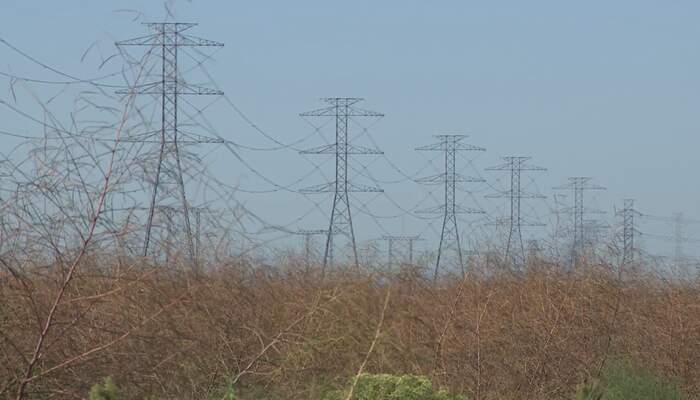
Texas does not have any 765-kilovolt transmission lines yet. The proposed lines would use massive steel towers reaching up to 200 feet tall — roughly the height of a 15-story building.
For comparison, many of the 345-kilovolt transmission lines already operating in Texas are about 100 to 150 feet tall.
These lines are designed to move large amounts of electricity over long distances. Think of them as the interstate highways of the electric grid.

The smaller lines and utility poles commonly seen in neighborhoods are distribution lines. They carry electricity the rest of the way to homes, businesses and rural properties.
Some large industrial facilities and data centers can connect directly to the bigger transmission infrastructure because of how much electricity they consume.
The initial push for major transmission expansion began in 2023, when lawmakers directed the Electric Reliability Council of Texas, or ERCOT, to develop a plan to bring more electricity to the Permian Basin.
The Permian Basin is one of the most productive oil-producing regions in North America.
The resulting plan included three major transmission routes, known as Import Paths 1, 2 and 3. Together, the proposed lines would stretch about 1,255 miles from Central Texas toward West Texas.
The estimated cost of those projects is $33 billion.
But the plans expanded in 2025.
CenterPoint Energy, AEP Texas and other utilities proposed an additional 1,100 miles of high-voltage transmission lines known as the Eastern Backbone. The additional infrastructure carries an estimated price tag of $9 billion.
That brings the combined proposed investment to about $42 billion.
A 155-mile section connecting Wharton County to Nueces County is the portion CenterPoint wants to build.
Former Public Utility Commission Chairman Barry Smitherman told ENOUGH the additional Eastern Backbone proposal was endorsed by ERCOT in December 2025.
The distinction matters: The original Import Paths were designed to move electricity to the Permian Basin. The additional Eastern Backbone would expand the transmission network beyond those original routes.
Residents like Michaela Bram question whether the additional infrastructure is being driven, at least in part, by the growing demand from data centers and other large electricity users.
About 85 miles southwest of Houston, in Wharton County, is Danevang, known as the Danish capital of Texas.
Founded by Danish immigrants in 1894, the community has a long agricultural history. Families have farmed the land for generations.

Michaela Bram’s ancestors were among the area’s early settlers. Her family has deep roots in the community, where rice, corn and cotton have helped shape the local economy.
Now, proposed high-voltage transmission lines could run directly in front of her property.
CenterPoint has already purchased farmland near Bram’s home. The land, which was previously used to grow crops, is now overgrown.
Bram said she wants more transparency about the plans and why her community is being targeted.
CenterPoint declined an on-camera interview with ENOUGH.
In an emailed statement, the company said it is in the initial planning stages of transmission improvement projects intended to improve reliability and resiliency across Greater Houston.
The company said it is conducting community outreach events and gathering feedback to help shape the projects’ designs.
Bram said she is skeptical that residents have the full picture.
“There’s too much happening for it to be hidden,” she told ENOUGH. “I mean, there’s gotta be something somewhere that they know, or we wouldn’t be doing all this.”

About 21 miles from Bram’s home, Amazon is developing Project Eagle in Boling.
The project is expected to include 13 data centers. Amazon says each will use about 60 megawatts of electricity.
Combined, that potential electricity demand could power approximately 468,000 homes.
Amazon told ENOUGH its project will connect to CenterPoint’s existing 345-kilovolt transmission infrastructure, not the proposed 765-kilovolt system.
The project is already bringing construction jobs and anticipated tax revenue to Wharton County.
Wharton County Economic Development Officer Courtland Holman said the development could benefit local schools, hospitals and the community college.
Amazon told ENOUGH it has already created about 1,000 construction jobs in the county. Once the project is complete, the company expects to have about 300 full-time employees.
Holman also revealed that CenterPoint approached him about finding a location for a large business development.
“CenterPoint asked me to find a site,” Holman told ENOUGH.
Through public records requests, ENOUGH obtained a nondisclosure agreement signed by Holman, the county attorney and the county judge.
They said they were told the agreement was required before they could meet with a major business interested in developing in Boling.
Emails obtained by ENOUGH also show Holman contacted the county judge on Oct. 31, 2025, about a meeting with a group represented by Jennifer Carroll.
In that email, Holman wrote that CenterPoint and the governor’s office were aware of the project and were being invited to attend.
Holman said the agreement was intended to protect confidential business information while the company explored its options.
Nondisclosure agreements are commonly used in business negotiations, particularly when companies are considering potential development sites.
When asked why CenterPoint would help recruit a major electricity customer, Holman pointed to the utility’s business model.
CenterPoint makes money by investing in infrastructure. The company can seek approval from the Public Utility Commission of Texas to recover certain infrastructure costs through customer rates.
That includes investments in poles, power lines and substations.
This is one of the biggest questions surrounding the proposed projects.
Utilities generally recover approved infrastructure costs through delivery charges on customers’ electric bills.
Those charges are separate from the cost of the electricity customers actually use.
https://www.texasconsumer.org/about
Sandra Haverlah, president of the Texas Consumer Association, said she does not oppose building the transmission infrastructure Texas needs. But she questions whether residential customers should shoulder costs driven by large industrial users.
“It’s not that we don’t need the lines, but the problem is there’s a causation for that,” Haverlah told ENOUGH. “If you’re building them for those companies, the residents shouldn’t have to pay for them.”
There is an important distinction: Residential customers are not paying for the electricity consumed by data centers simply because those facilities use large amounts of power.
When a data center connects to the grid, the utility generally requires the business to pay for the infrastructure needed to connect it.
However, the cost allocation for larger transmission system upgrades is a separate issue.
A 2023 law was intended to require the entities driving transmission costs to pay their share. But the rules for calculating those costs have not yet been fully developed and implemented, according to the experts interviewed by ENOUGH.
Large electricity users also pay delivery charges. But because of their enormous electricity consumption, they can receive lower delivery rates per kilowatt-hour than residential customers.
Haverlah said that raises questions about fairness.
“If you wanted to be fair about it, you would do actual usage, which is what residential customers have right now,” she said. “Why not just charge them their portion of what they use?”

Smitherman, who previously chaired the Public Utility Commission of Texas, is pushing for a different approach to building the proposed transmission lines.
He created a nonprofit called Texans for Affordable Transmission and wants state lawmakers to require competitive bidding for the projects.
Currently, utilities generally develop projects within their service territories and seek approval to recover their costs.
Smitherman argues that allowing other qualified utilities and private companies to compete could bring down construction costs.
“Competition is good,” Smitherman told Amy Davis. “But this is the one area where we don’t have competition.”
Smitherman cited a study estimating that competitive bidding could save ratepayers as much as $22 billion, or up to $640 per customer annually.
His proposal would allow qualified companies to submit bids, with cost caps designed to protect customers if construction costs exceed estimates.
Davis asked CenterPoint whether it supports opening the projects to competition.
In its emailed statement, the company said the projects would be “built by Texans for Texas.”
Smitherman hopes to work with lawmakers during the next legislative session.
Although the Public Utility Commission has not issued construction permits for the proposed 765-kilovolt lines through Danevang, AEP Texas crews are already working on substations that could connect to the new transmission system.
Bram told ENOUGH one large substation near Hillje has been under construction for about a month and a half.
When an ENOUGH photojournalist traveled to the area to document the construction, an AEP employee parked behind the news truck on a public road and demanded to see identification.
The employee eventually moved his truck, allowing the photographer to leave.
ENOUGH emailed AEP Texas twice to ask why the company was building substations associated with a transmission project that has not yet received final approval. The company did not respond.

The Public Utility Commission provided a statement explaining that substations and other facilities associated with a proposed transmission project may not be subject to the same approval requirements as the transmission line itself.
That leaves another important question: Who is paying for the substations and other preliminary infrastructure?
Haverlah said the rules remain unclear.
“We know it’s coming. We know the bill is coming, but we don’t know how it’s going to work out for customers,” she said.
Smitherman believes construction should pause until lawmakers have an opportunity to consider competitive bidding and other cost protections.

ENOUGH asked Lt. Gov. Dan Patrick how Texas got to this point.
Patrick said he has concerns about how the Public Utility Commission and ERCOT have been leading the state’s electricity planning.
“I have no confidence right now in how the PUC and ERCOT has been leading,” Patrick told ENOUGH.
Patrick said he intends to work on two issues during the next legislative session:
The next Texas legislative session begins in January.
For Bram and other residents in Wharton County, the uncertainty remains.
“We’re waiting to see what is coming next,” Bram said.
ENOUGH will continue monitoring the proposed transmission projects, the cost to electricity customers and what state lawmakers do to hold utilities accountable.
MORE: Check this map to see if high voltage lines will be near you.


